
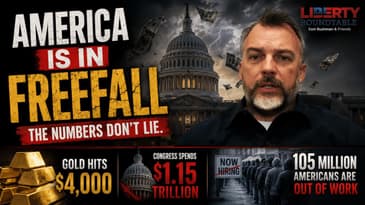

[00:00:04] Broadcasting live from atop the Rocky Mountains, the crossroads of the West. You are listening to the Liberty Roundtable Radio Talk Show. Sad to say, oil's up, nukes are everywhere, Americans are out of work, or choosing not to work, it's a debate.
[00:00:33] The House spinning us into oblivion, and I'm Sam Bushman with your hard-hitting news the network which refuse to use, Honest Money Report, that means our brother Heath Perkins with us from Free Water Coin Co, and we've got to talk about Honest Money, that's for sure. Welcome to the broadcast, sir. Thank you, Sam. Thanks for having me back. Let's kick it off right. Where's gold sitting, my friend?
[00:01:00] Gold's at $4,044.90 right now. Let me say this right, just so I got it. $4,044.90. Okay, so $40,44.90. Okay, so it's sticking around, basically around the $4,000 mark there, ladies and gentlemen. Silver?
[00:01:29] $57.83. That's way down for silver quite a bit, even though it's, I guess you could say it's up compared to where it's been, but it's down from the last little stint, right? Correct. What gives? It's down a little bit. Why? What the heck's going on? That's the, I mean, in precious metals, you always have a summer doldrum that happens. It kind of slows things down.
[00:01:57] So a lot of your affluent traders that are out there that are trading in the futures markets, and that's really what drives this price is the futures market. But they're away on vacations. They're doing things over the summer. And so a lot of the summer, it just tends to go a little bit sideways or just in a downward trend. And this usually picks back up in about September and really heavily in October. All right. What do you think is going to happen? Are we going to have an October surprise?
[00:02:26] This is a very interesting midterm election. The Democrats got spanked really hard in 2020, you know, four kind of thing. And, you know, then now they're saying they're going to come back with a vengeance and, you know, it's all up in the air. Many people say they're going to lose the House, lose the Senate. I'm kind of wondering a little bit more, you know, they say it's the economy stupid. I'm wondering about the economy. Do you think we're going to have an October surprise or something's going to happen? Or do you think it's going to be stable?
[00:02:52] I tend to think that if we don't see an October surprise, we're going to have something very interesting happening in 2027. Everything's kind of coming to a head, whether it's the financial arenas around the world where most nations are losing the ability to pay the interest payments. It's getting harder and harder to do that.
[00:03:17] To, you know, war and economic instability that's caused by that. So there's a lot coming to a head right now simultaneously. And so that's why I think if we don't see something in October, it's going to be something in 2027. It's going to be something that shanks us up pretty good. All right. Let's talk about some of the things that relate to you saying everything's coming to a head because I agree with you. There's a lot of tidbits going on.
[00:03:45] The first one I've got coming out of the gate, the headline says this. 105.8 million Americans are, quote, outside the workforce as labor force hits low since 2021. And they say a record 105 million. They're classified as not in the workforce. That's according to the U.S. Bureau of Labor Statistics.
[00:04:13] That's published by the Federal Reserve of St. Louis. And the category, by the way, though, includes retirees, students, people with disabilities, caregivers, others who are not currently working or actively seeking work. So, you know, it's not just people who aren't unemployed. I mean, if you're retired, if you're a student, they may not need to be employed. But the alarming number relates to this.
[00:04:39] The labor force shrank by 832,000 people in a single month. They say pushing the labor force down to 61.5%. That's a low. And economists are saying, hey, understand that much of the increase reflects, you know, baby boomers retiring and everything else. The labor force, though, is really suffering because young men are simply refusing to work at unprecedented levels.
[00:05:08] Is that part of what you're talking about, Heath? Yeah. So you have a lot of it. So quick, in 1964, $1.25 was minimum wage. And that $1.25 in silver quarters is the equivalent to about $52 an hour today. So the ability. Whoa, say that one more time. That number's startling. Hold on. Say that again. Yes.
[00:05:35] So in 1964, $1.25 was minimum wage. That $1.25, because they had silver quarters then, that $1.25 in silver quarters is the equivalent to $52 today. Woo! Woo! So that was their minimum wage. That's great every year, baby. It's nuts. It's $104,000 a year was their minimum wage compared to our money today. So our money is worthless. People understand that.
[00:06:04] People know that it takes so much more, the gig economy kind of thing, so much more to actually make it these days. Because the hope that was there for the American dream has really, really struggled. And a lot of youth are feeling that. And they're just like, I won't have what my parents have. I won't have what my grandparents have. I won't have those things. Because there's no reality that I can see right now that will achieve that. So it's a struggle for them.
[00:06:32] But one of the things that I researched back in the day when Obama got into office was the unemployment numbers, they started taking people who were more than six months unemployed off of the workforce. So they just no longer were part of the workforce, regardless if that was the... Yeah, you're tossing them in no man's land, if you will, right? Exactly. Exactly.
[00:06:56] So the numbers that they want to get, they can keep changing the formula and get to where they want to get with unemployment. But when it comes down to it, you have this very interesting dynamic when it comes to... They don't count individuals who are still looking, who haven't found that job after six months. Like, that's still part of the workforce.
[00:07:24] But they don't count it anymore because they don't want the numbers to look bad for unemployment. We've struggled with them playing around with formulas for a very long time from the consumer price index to the unemployment numbers. It's just, again, like you have a bean counter that literally asks the individual, like, what number you want to get to? And I'll change the formula to get there. And they can do that. And they've done it multiple times.
[00:07:49] So, but what we're really seeing is a struggle, not just on a individual level, but on a national level. The nations are starting to lose their ability to afford their interest payments. We are so far in debt. These interest payments are getting to a point where every nation is struggling. And that's where I'm saying everything's coming to a head.
[00:08:15] Like, financially, the debt the world has accumulated is so severe. And this has never happened before. Like, before you'd have a nation here, a nation there, and sometimes a couple together due to wars and things like that. But we've never seen a moment in history where all nations simultaneously come to a point where they're all this strapped with debt, as well as a lot of their citizens.
[00:08:43] I mean, here in the U.S., we're sitting over, I can't even know, I don't even know the numbers. I know it crested over a trillion in credit card debt. I don't know if that's gone how much higher than that. But worse than that. You've got student loan debt that's way out of control, too. So if you're a student, you're just racking up debt as part of the problem. People are deciding to go to school because they say there's no work. But maybe I can get something at the end of the rainbow here. If I go to school for a couple of years, maybe things will improve.
[00:09:11] You've got a lot of young men that are saying, listen, man, I'm not going to get married because, you know, all the women are witchy women. They're taught that women are horrible and women are taught that men are horrible. So they've destroyed marriage in America. Plus, it costs more to get married. So guys are just saying, hey, I'm single. I don't need a lot of money. I can live in my car. I can be on the road or I can, you know, find a little trailer somewhere or I can couch surf or I can do this and I can do that. And they've really found a way to live really, really, really inexpensively and not need to work per se.
[00:09:41] They can just pick up odd jobs here and there so nothing counts. And they're just kind of waiting to see what happens in the economy. It's like waiting for the other shoe to drop. It's a little bit chicken little-ish in the sense that they're waiting for the sky to fall or something like that. It's really a sad reality, but they're just refusing to work because they're like, hey, I can't accomplish anything anyway. And even people that I know that do work that have families are saying, you know what? I appreciate that I make 80 grand a year, 100 grand a year. But frankly, it's just not enough money now.
[00:10:10] I mean, really, you just documented at the start of this whole segment that 100 grand a year is like minimum wage in 1964. So people are going, I just got to have a raise. I can't support a family like this. Sadly, it's true. And where I live in Utah County, they just had a cost analysis for some of the areas that were at $625,000 for a house. Who can afford that kind of stuff? Heath, your house payment's like five, six, seven grand that way. It's insane.
[00:10:39] Anyway, when we come back, we'll have Heath respond to that. I also want to get into Congress is spitting us into oblivion. I'll tell you about it. We'll do it in seconds. I'm Sam Bushman, Heath Perkins with me, freewatercoinco.com. You've got a friend in the honest money business. How's that? All right. We'll talk more in seconds. All right.
[00:11:04] Back with you live, Sam Bushman, Heath Perkins, freewatercoinco.com on your radio and TV. So Heath, I was saying right before the pause, these young men have just given up. They're like, man, I can never achieve anything. I mean, if I make 100 grand, it's minimum wage for crying out loud. I can't cope. I'm not doing it. So they just find ways to live flat out, cheap as all get out. And they're just like, hey, man, I'm just going to hang out and see what happens. There's nothing else for me to do. And when you start to create a nation of no hope, you know, you can run around and talk
[00:11:33] big if you're a politician and you have plenty of money that everything is fine. But people know better internally in their hearts and their souls. They're going, hey, man, you can say whatever you want to. But I know the truth, Heath. No, completely agree. There was a good study that came out. A lot of psychologists and psychiatrists wanted to know what was causing suicide rates to spike.
[00:12:01] And a lot of people think it's, you know, medications and things like that. And that was, you know, about 50 percent of the individuals that were in those those categories had that. But the biggest thing that caused the suicide rate to spike was hopelessness. We we are at a point where helping individuals that are young with hope is is going to be what gets them through.
[00:12:30] Like like there truly is a lack of hope right now when it comes to the physical things in this world. And that's why we need to start flipping things instead of the hope of the physical being getting better. The hope that the spiritual is going to get better. We need to go back to a point. And the sad part is some people are even saying, hey, you know what? If you have too much hope, you're delusionary. They're calling it now you're on hopium. Yeah. Because it's so bad. They're saying it's not real is the problem, right?
[00:13:01] Well, if you can't think optimistically, it's hard to get out of any kind of situation. You're kind of you're kind of limiting yourself to this is where I'm at. These are these are the you know, the frequencies I'm putting out. If you want to want to say that, you know, and what you get back is not going to be a positive thing either. And so like we have to understand that, you know, we are in more of a spiritual scenario.
[00:13:29] And we keep thinking physical things are going to solve our spiritual problems. We have a lot of spiritual problems in this world. And the hope is going to come from the spiritual side. It's not going to come from the physical side. It doesn't doesn't matter how many things you have. There we go. Yeah. It doesn't matter how many things you have. They can't make you happy. They can't give you the hope. It's understanding your relationship with the divine that that allows us to gain the hope that we need.
[00:13:58] We need to understand and go back to a God fearing nation. Go back to a humble nation that's willing to submit in a sense to to a higher authority and let them let let's the higher authority guide us in our lives. Like we need to get back to God and to that spiritual side of things. That's where the hope is going to come from. I couldn't agree more. In fact, young men are turning to religion more.
[00:14:25] They're startled about how young men are turning back to going to church and turning back to religious things. And I do think that is where the hope needs to come from. Congress doesn't see it that way, though. Congress just went out of control. The Republican backed House just voted ninety five billion dollars. It includes funding for the Iran war. They call it the Iran conflict because they don't want to say war because they have to admit that it's a non declared war. So they use the word conflict to play games here.
[00:14:52] But it's a, you know, ninety five billion to fund the war and deal with election related initiatives. The measure now moves to the Senate. They say that's ninety five billion for that alone. Then they also approved House approved nearly one point one five trillion. That's a T trillion dollar defense spending authorization. So NDA passed.
[00:15:19] And the bottom line is it's one point one five trillion. That now goes to the Senate. So, I mean, they're just spending us into oblivion. And what they don't really understand as far as I can see, Heath, that's just going to add insult to injury, my friend. Yeah. Well, yeah. Like you talk about these young men not having hope. Well, on top of that, they know how much we're ramping up the spending on war. Like and they're the individuals of the fighting age to have to go to these wars.
[00:15:45] Like like I would be discouraged as a as a 20 year old these days because like, yeah, I can't afford things. And then on top of that, my nation wants to go to war and I'm probably going to get pulled into that. Like that's there's a very I mean, I can understand. I truly understand how these youth are struggling with these ideas that, hey, where where where's the shining light? Where's the light at the end of the tunnel on this one?
[00:16:12] Because they're not seeing it and nothing that Congress is doing. I mean, this is one point five trillion versus one trillion prior. You know, so a full 50 percent increase in the budget you got there for the defense. I mean, we are looking at obviously wars in the future. We're looking at higher prices across the board with fuel going up. The oil price is going up because of this these conflicts that we're in. We're seeing inflation continue to go up.
[00:16:42] I don't think we're going to see this year interest rate drops. We're probably going to see interest rate holds or hikes due to we just can't stop the inflation. Things are just constantly getting more and more expensive. The housing price, like you said, in Utah County here is six hundred and twenty five thousand dollars. I've got I've been priced out of this county. I actually bought land in a county south of here because I couldn't afford this this county anymore. I've lived here since I was five.
[00:17:11] And I can't afford this. So I'm not quite out of the scenario as these these 20 year olds in the sense that, you know, building something or growing something is still in my near future. But it is getting a little bit of a struggle. And the hope is is fleeting when it comes to the physical again.
[00:17:30] So so like I mentioned before, we've got to go back to solving spiritual problems, hope and hopelessness and and and things of this nature where we have depression and things that come from that. We need to solve these spiritual problems with spiritual things. We need to stop thinking that the physical is going to create the happiness, create the drive, create the hope in us.
[00:17:55] But I honestly see how these these young men, they feel like they're going to have to go to war and fight someone else's war and they can't even afford to live. Again, like I stated before, like one hundred and four thousand dollars is the equivalent of minimum wage in 1964 in our dollars compared if you're comparing silver. It's it's a really difficult scenario to be in. But the hope truly comes from the spiritual side.
[00:18:24] And this is why they're all flocking back to it. No doubt about it. It turns out that oil prices climb to a six week high as the U.S. War continues. Also, the U.S. Secret Service now reporting that the threat environment is the highest we've ever seen in 2026. That means the U.S.
[00:18:47] Secret Service is saying, hey, the threat of assassination or murder, whatever you want to call it, for a lot of the high profile officials is at an all time high. That's not a good thing at all. Right. Right. And then we sign a nuclear agreement. It's a nuclear cooperation agreement with Saudi Arabia. That sounds good right now because they say they're going to use it for peaceful purposes and for power. But how long till that'll change? Energy secretary.
[00:19:18] His name is Chris Wright. Basically said, hey, they signed this agreement. It's all good. But how long will it be till there's a bad actor there over there that then decides to use it for sinister purposes? And then that'll escalate even further. Other are concerns. Then the Trump administration broadens technology exports to the United Arab Emirates. The administration approved wider exports of advanced U.S. technology.
[00:19:50] Despite external concerns or other people saying, you know what, that can backfire and end up in the hands of the Chinese. So I don't know where this goes, but I think everything we're doing is bringing this to a brink as you bring up, Heath. That's why I mentioned this. Yeah. No, we are. We are shooting ourselves in the foot again and again and again. And it seems like this is just the momentum that we're taking.
[00:20:18] It's almost like we have to decrease America's ability to actually stand as a nation in order for us to move forward in this new system that they're creating.
[00:20:34] It's a very weird scenario where everything that's happening has been to degrade and to undermine the U.S.'s ability to provide for its own nation and be self-sufficient here. Yes, we have the ability to print money because we have the reserve currency. And that's the only thing that's really kept us going.
[00:20:55] But even all the way back to, you know, George W. Bush opening or George Herbert Walker, the older one that has passed away, he opened up China to the rest of the world. And part of that agreement with China was if you use Chinese labor, you also have a Chinese partner, which means they have access to all your patents. So when Caterpillar went over there, when Boeing went over there, they got access to all the patents of these top-end corporations.
[00:21:25] And they got to leapfrog all of the R&D that they needed to do to catch back up to these companies. And now they just have the patents. I mean, this is the reason why China has caught so quickly up to these superpowers in the world. It's because as soon as you utilize them for their cheap labor, you had to agree to a government partner. And that partner had rights. And American leadership basically abated, I'm sorry, aided and abetted the enemy, if you will, on that.
[00:21:54] It's a tragic reality. The problem is there's no way to back away from that now is the problem. But now the headline says crypto legislation gains momentum in Senate. Washington prepares for massive crypto shift. A long-awaited cryptocurrency bill is advancing in the U.S. Senate, potentially reshaping asset regulation and the future of the crypto markets.
[00:22:21] You only got about 40 seconds, but respond to that really quick, will you, Heath? Everything's going to the crypto markets. Everything's going to be digitized. Everything's going to have a part of the blockchain. Doesn't matter what asset class it is. I mean, the whole entire stock market's being transferred over to a digital system right now. A tokenized digital world with the government having a thumb on the scale, ladies and gentlemen. It's disaster. We better wise up quick.
[00:22:50] Thank you, Heath Perkins, my friend. We'll talk soon. Okay, sounds good. Thanks, Sam. You betcha. Freewatercoinco.com, ladies and gentlemen. You're talking a real honest money solution at your fingertips. Make sure you hedge your bets and stabilize your portfolio. Freewatercoinco.com. I'm Sam Bushman. God save our constitutional republic.
[00:23:13] Money report continues.
[00:24:30] So there's a lot of news. So there's a lot of news going on. But this one I really want to dig into with you a little bit, Heath, because this is critical. Headline says, crypto legislation gains momentum in Senate. Washington prepares for massive crypto power shift.
[00:24:48] And then it says a long-awaited cryptocurrency bill advances in the U.S. Senate, potentially reshaping digital asset regulation and the future of crypto markets. They're going for broke on this one, buddy. Yeah. No, it's – this is the direction they've been wanting to go. I mean, BlackRock just backed it all. They're tokenizing everything right now. And they are in a frenzy to tokenize everything by the end of the year.
[00:25:19] Or not – well, as much as they possibly can by the end of the year. Their goal eventually is – Maybe I have to start the phrase no-no-toke, huh? Yeah. No-no-toke. Yeah. But it's a struggle because this is Trump's ability to sell debt. Like you can't sell debt to other nations because no one wants it because they know how far in debt we are. And so what did Trump find?
[00:25:47] Trump found all the stable coins to sell the debt to. And every bit of debt that they buy turns that into a digital currency, a digital token that can be utilized out there, USDT Tether. So it's starting to get to a point where Trump doesn't want a central bank digital currency, but he just handed over the central bank digital currency to a private institution that is buying our debt.
[00:26:14] So it's like we're feeding the very beast that is going to create a central bank digital currency just in private hands versus more of a public entity that we can vote people in that can stop. Like you don't have a say when it comes to the private side of things. So this is – I see a bit of a danger here with this.
[00:26:37] Yes, it's another individual by our debt so we can keep going forward and we can keep kicking the can down the road and we can keep borrowing endless amounts of money that we can't afford. But at the same time, you don't have any regulation that can stop these private institutions from doing what they want with this digital currency.
[00:27:00] If they get the rights to do all the digital currency like we're seeing from the debt that's being purchased from the US, this is insane where – like if this was a central bank digital currency, we would have a bit more say. We would have the ability to vote people in and out that could actually do something. This is a private bank. This is a private institution where you don't really get a say on how things are ran with their business. But we're being corporatized. Double-edged sword on this one.
[00:27:30] We're being corporatized and turned into a fascist nation on all fronts though. Donald Trump buying stakes in businesses left and right. We did this with the auto industry back in the day. Big time. We create moral hazard by this where you're going to have more and more and more government involvement in private business to the point where I don't know that we're going to be able to back away from that. And then if you move it to a digital currency, you tie more to the government. So, yeah, people can compete in the currency world.
[00:27:58] But at some point, they'll say the Federal Reserve has to be able to control all currency in the dollar world or the gold and silver world. You can't create your own currency or you're a – what do they call it? Counterfeiter. And pretty soon they're going to say, hey, you know what?
[00:28:13] We can't have counterfeit digital currencies competing because if you have bricks competing with the U.S. dollar over the oil market and or whatever, and then you have basically digital currency competing with the American dollar on that side of things, and you have these private currencies out there that everybody's trading in, at some point they'll say you can't do that. It's counterfeiting. They'll have to or they'll lose the game, right? Correct.
[00:28:40] We want to maintain the reserve currency ability that we have, which is – gives us a right to literally print money consistently and continue to issue that without any kind of like oversight that we would normally have. And the downside of us printing is the rest of the world kind of has to follow suit due to our price, our value of our dollar is going down.
[00:29:08] So the rest of the world wants to bring their currency values down so that they can continue to sell to us. So the right that we have, it's a lot of power. A lot of power comes with the ability to be the reserve currency. And if that's being threatened like the BRICS nations are trying to right now, it's up for grabs.
[00:29:32] There's a lot of nations that are now siding with the BRICS, including United Arab Emirates, Saudi Arabia. A lot of these nations are over there looking at, okay, this seems to be the route that we should be taking. The BRICS nations want to go with a physical gold and silver backed kind of a central bank digital currency where the U.S. wants to go with more of a debt backed central bank digital currency.
[00:30:00] I see theirs as, you know, a precious metals individual that that is the better option of the two. When you're backing a digital currency with just debt. I mean, that doesn't give anyone confidence that you're going to be fiscally responsible because you're just adding more debt to the problem.
[00:30:23] So a lot of people are seeing what China, you know, all the BRICS, Brazil, Russia, India, China and South Africa, plus all their additional inductees into that group over the last couple of years. They just, they are leading the way. And a lot of the world due to our relations internationally has really been put off by the U.S.
[00:30:50] And we have lost a lot of our good friendships that we've had in the past. A lot of people have been called on the, on the carpet and then said, hey, you guys need to start covering your own debts, your own bills, your own, you know, purchasing into these, these programs.
[00:31:10] And we've stopped, you know, supporting in the way we've supported in the past, but we've also made some very, you know, strained relationships internationally due to this as well.
[00:31:22] So it's, it's, it's hard because BRICS really has a good position right now where they are coming in with a very strong system that, that is more sound than ours due to it being backed by something real versus us backing it by debt. So I don't, I don't see how their nations don't see that as a benefit.
[00:31:45] And if they want to go with something more real and less debt based, I mean, that, that tends to be the direction they take is going to BRICS. Well, here's the concern that I have, Heath, right now, that the dollar's certainly volatile as we've seen, right? And certainly oil has got some volatility because of, you know, it's controlled through the Straits of Hormuz or only a few places. Gold and silver could be accessed anywhere in the world. It seems like when people obey God, they can find gold and silver.
[00:32:12] And when they don't, gold and silver is very slippery and difficult to find. But I bring this up because I think digital currency is even more volatile than that. It's subject to memory chips. It's subject to digital data mining, which means make computers, you know, run algorithms to generate. If you have memory problems or hard drive problems or component problems for computers or if computers go away instantly or a power turns off or any of those other things, it's much more subject to volatility than even the U.S. dollar, which I know sounds impossible.
[00:32:43] But I'm convinced they're true to that. And so we are going to go from the frying pan into the fire with volatility if we embrace digital currency from political battles to, I mean, who knows what, right? No, I agree. I've been doing a little research on the tokenization, which is right alongside the digital currency stuff. And if there are breaches within certain data systems, they can burn all the tokens and reissue those tokens.
[00:33:08] The downside is when you reissue those tokens, the ownership does not transfer to that new token. So there's going to be a heyday if we have any kind of a data breach in these tokenized systems. We've all known the digital system has had issues. Ever since we started with dial-up, we've known that things have had issues. So a lot of the world's mafia is going after these cyber hackers that can go in there and...
[00:33:39] Go ahead. Hold on. Stay right there, my friend. We've got to keep the hostage for another 15 minutes, okay? Okay. Don't move anymore, all right? All right. Stay there. It isn't going to be fun for you, my friend, all right? Hold on. All right, ladies and gentlemen. Heath Perkins with me, ladies and gentlemen. FreeWaterCoinCo.com. We've got an incredible hour today with Heath Perkins with me.
[00:34:11] FreeWaterCoinCo.com. We're talking about honest money. We're talking about the concerns moving to digital currency. Spending ourselves into oblivion. The young men won't even go to work because they're afraid. Why do that? There's nothing for me there. I can't make enough money to do any good with the inflation out of control. And not only that, I'll probably just get sent to war. So what's the incentive for me? And it's a tragic reality that we're facing as America turns away from God and away from godly ordained marriage and families because there's no way to support a family.
[00:34:40] Well, anyway, I want to throw this out. I believe that digital currency will make things even more volatile than they already are from an economic standpoint. And so what I did on one of the breaks is I put in Heath Perkins claim. He said, hey, in 1964, minimum wage was $1.25. And now in real money based on constitutional currency, gold and silver, that would be about $52 an hour today. That would be minimum wage, people.
[00:35:07] And so I put that in the chat to you to see what chat to you would say about it. Kind of a fact check in a way. And it fact checked by doing the following. I think this is really incredible. And I want Heath to be able to respond to this. They say the short answer is yes. A figure of around $52 an hour is if you use gold and silver as the measuring stick. So they admit Heath is exactly 100% right.
[00:35:36] The short answer is yes. Then they go on, though, and the explanation is the weirdest thing I've ever seen in my life to try to get around admitting the truth. So it says this. But a big, huge but there, Heath. No, it's not accurate. If you're talking about inflation or purchasing power, they're completely different explanations. Then they say this. Comparison one. Inflation is the standard government measure.
[00:36:08] 1964 federal minimum wage. Yeah, it was $1.25 an hour. Adjusted using the Consumer Price Index, CPI. It's really $13 to $14 an hour if you kind of compare it to that. So they say by the government's inflation measure, $52 an hour is not correct. Then their second argument, comparison two, the silver is the sound money comparison.
[00:36:36] This is where the much higher number comes from. And then they admit what we're saying. They do the five quarters equals a dollar, you know, et cetera. And then they compare silver. Then they compare gold. And they admit in both cases it's correct. In fact, it might even be higher according to current silver and gold prices. But on the average, Heath is right. And then they say this. And this is the most important part. Then I want you to respond, Heath. Why people disagree.
[00:37:03] The disagreement isn't really about the arithmetic. No, sir. It's not about the math, Heath. It's about which yardstick we should use to measure the value of labor. However, economists generally use government numbers, not sound money. Sound money advocates argue that gold and silver are the best long-term measurement we have.
[00:37:29] Precious metals preserve purchasing power better than government inflation and fiat currency. They say both mathematical equations are mathematically valid, but they answer different questions. Okay. And that's the debate now. How many dollars buy the same basket of goods? And they go on and on. But at the end of the day, what they're basically saying is, look, the government decides the terms and the details, the definition of words. And if you go with the government's definition, you're wrong, Heath.
[00:37:59] I am wrong. I'm okay with that. I mean, think about that explanation, though, how psychotic that is. It's like we've got math and then we've got girl math. Okay, Heath? And girl math is just as valid as math. Not. Do you want to respond to this? It's insane. So the reality is if you make it simple, like I made it simple, the simple numbers show the truth.
[00:38:22] If you can convolute and make things complex, you have to bow down to an authority to give you the answer. So these authorities want these complex CPI things. And this thing, like I was talking about earlier, they can change the formula on how they get that number for CPI. Like CPI used to be a certain baskets of goods, which included steak to begin with, and now it includes hamburger.
[00:38:51] So they substitute steak for hamburger and they say it's the same thing. So they can alter their formula, their complex formula on how to come out with, oh, this is what inflation truly is. I'm just showing you the simple math. $1.25 in 1964 was five quarters. Five quarters, they were all silver. That silver translated today is $52. It's a simple formula. Anyone can do it. Anyone can see it.
[00:39:20] But they want complexity. So, yeah, that complexity is the struggle we have. The complexity of we have to have an authority that we utilize in order to understand this complex thing. We don't need complexity. We need simplicity. If you can't teach these things to an elementary school kid, you shouldn't be teaching these things.
[00:39:42] There shouldn't be an authority out there that can change things at a whim and alter what they measure things by. And that's what they do with the CPI. So it's hilarious because all they want is to be the authority. All they want is to create complexity. All they want is to shade the things that they don't want you to see. And that's what they've done.
[00:40:07] We don't see that if we had sound money, if we had silver, that it'd be worth $52 today. It's minimum wage. Like it was in 1964. It's just a bunch of shady ways of getting people not to acknowledge real truths, which is our dollar has lost insane amounts of value. We can't purchase anything like we could purchase in the past. That's on us.
[00:40:37] Our struggle really comes down to is we don't understand money. Therefore, we're going to continue to get bamboozled by money. We don't understand what money is. And because we don't understand it, they can take advantage of us. And they do. Again, it's the complexities that are the struggle. And we need to start making things more simple. Anyone can understand what I told you earlier in the show about $1.25.
[00:41:06] You can go and do the math on that. You do the chat GPT to fact check me on that. And their answer is such a 1984 double speak kind of a statement I've ever heard. Like, yeah, you can trust the sound money thing or you can trust our government numbers and that we're keeping those legitimate and we're not changing out certain things from our CPI. I mean, it's insane.
[00:41:33] This is the insanity that we deal with, Sam, is there's no clear voice out there that goes back to simplicity. They all go to these complex things because they want to be the authorities. Very few people can understand these complex systems. And they know that. They thrive on that. And that's why they stay on top as they make everything so complex. All right.
[00:42:00] So the headline for Heath Perkins today is this, ladies and gentlemen. What happened to the U.S. dollar? A $1.25 minimum wage in 1964 is about $52 an hour today in gold and silver. Honest money. Hey, Heath. Want to get that for a headline? Yep. I 100% agree with it. Anyone can.
[00:42:30] Yeah. Anyone can fact check that one. Go for it. But that's why you see the youth have such hopelessness. I mean, I can simplify it to that kind of an answer to where it's like, yes, you'll see the hopelessness because they're not making $52 an hour. They're not making the equivalent of purchasing power to 1964. Is that $52 an hour? We're not seeing that.
[00:42:56] I don't know anyone who's jumping right out of college, making $104,000 a year unless you're a doctor or you're a lawyer. Well, but who wants to go to college for minimum wage? Yeah. Exactly. Yeah. I mean, come on now. You're supposed to make minimum wage without going to college. That's if you don't even have a high school degree. You should be able to make minimum wage if you have a skill. Minimum wage isn't what you do when you get out of college or something, is it? No. No.
[00:43:25] So even that is a sham, folks. And that's the problem we're facing here is that we're not admitting true money. And what they want to do is move you to this alternative discussion about what they claim to be buying power. Right? So, you know, you used to buy Charmin. Now you buy one strand or one ply toilet paper and they're saying it's equivalent because you can buy TP. It's a lie, folks. It's a manipulation. It's not true.
[00:43:50] And the bottom line is people can see it because whether you can understand their complicated debt-based currencies versus real, honest, godly asset-based money is they want to try to fool you with economics and fool you with, well, you got to have a degree in this to understand, Sam. And here's my response. You don't need to tell me nothing. When I go to the store, I understand. Isn't that that simple, Heath? Bingo. Yeah. We all feel it. Like we all like, oh, yeah, 3% inflation or 2% inflation or 1%.
[00:44:20] But, yeah, right. The cost of just the day-to-day expenditures is nuts. Every time I go to the grocery store, it's that way. Every time I go, I mean, good heck, I'm paying $180 an hour for a diesel mechanic. Yeah. Like it's not a cheap scenario anymore to own a diesel vehicle, a diesel truck. I mean, it's insane.
[00:44:50] Well, how much is a gallon of diesel of gas now? Oh, $525 or somewhere in that range. It's, yeah. So it's up there. It's almost the same as a quarter pounder, a Big Mac. Now you go to the Big Mac index and it shows the same reality check, right? Exactly. All right, ladies and gentlemen, constitutional currency. That's what it's all about. If you want honesty in the economic discussion, we're here to bring you the honest money report with Heath Perkins, ladies and gentlemen.
[00:45:18] Heath Perkins from FreeWaterCoinCo.com. Get a hold of him if you want to hedge your bets and stabilize your portfolio with honest money. Thank you, Heath. You're welcome, Sam. Have a good day. There he goes, doing a phenomenal job. As always, you are watching the one and only Liberty Roundtable Live. It's always about God, family, and country. Our goal to promote God's family and country everywhere we go in the media and our lives.
[00:45:46] Defending truth, freedom. And we know that the Savior Jesus Christ will return and that's where we put our hope. God save our constitutional republic.