
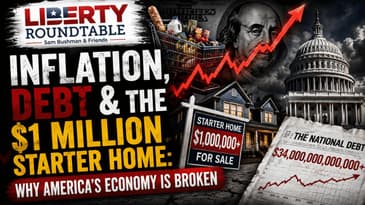
[00:00:04] Broadcasting live from atop the Rocky Mountains, the crossroads of the West, you are listening to the Liberty Roundtable Radio Talk Show. They say inflation's cooling. Boy, howdy, do I wish it were true. Happy to have you along, my fellow Americans. Homes in many cities reach a million dollars.
[00:00:29] That's out of reach in hundreds of cities for the average American, that's for sure. Now, the mainstream press, ignorant about the economy, sad but true. Don't mean to be offensive with my comments, but they're kind of wondering, hey, if inflation's cooling, why are prices so high? Well, let me explain something to you people that you don't understand. The reason prices are so high is because we've had 2% inflation forever. Well, just so you know, 2% inflation over a number of years becomes 100% inflation.
[00:00:58] And over time it gets out of control. And if that number goes above 2%, 3, 4, 5, 6, 8, 10, 15, it doesn't take long to make that change. You add to that the inflationary numbers and you add food shortages due to all kinds of climate issues, man-made or otherwise. You add to that housing crises for a variety of reasons, primarily illegals in America taking up tons of housing.
[00:01:25] If we've got 10 million illegals in the country, 10 million people need housing, folks. So that ratchets up the cost of housing. Then you have the oil embargoes and oil battles, if you will, worldwide. Everything costs more to ship. And when prices go up like that, up, up, up, up. Yes, they might not be going up as fast as they once were under the Biden administration or the last couple of months, but they're not coming down.
[00:01:55] They're just not going up fast anymore. Anyway, I digress, but it's very interesting to see. Also, people are depending on more and more and more bills in their lives, right? So it's not only inflation that's the problem. It's I've got more bills. So think about it. Yet younger generations or generations. My parents, I should say older generations, maybe my parents, their parents, you know, they didn't have an Internet bill. I have one.
[00:02:25] They didn't have an AI bill. I have one. They didn't have an air conditioning bill. I have one. They didn't have multiple cars. I have them. They didn't have multiple TVs. I have them. They didn't have multiple entertainment accounts of different kinds. I have them. I mean, shall I keep going to make the point? So part of the problem is inflation. I get it and don't disagree. But the other part of the problem, ladies and gentlemen, sadly, so is that we have a lot more obligations than we once had. Right?
[00:02:55] I mean, even if you have kids, you've got to spend money on car seats. When I was a kid, we didn't have car seats. We just bounced around in the car. Now you're like, well, it's safer, Sam. You guys were idiots. You're right. We were very, you know, carefree and careless. You guys are a lot smarter in your younger generations to keep kids safe in cars. That's all true. But it doesn't change the fact that it costs a bunch of money for car seats. Yeah, you also have to have a car that's bigger to fit all the car seats. Right? The car seats now are massive.
[00:03:27] Right? And so, you know, we go out to eat a lot more than we used to. Food costs more than it used to. We have, you know, a lot. When I was a kid, diets were fairly simple. Now diets are complex. I mean, you've got to learn how to make all kinds of different cultural foods. Right? Everybody knows how to make pad Thai or Chinese this or Italian that or Asian this or whatever. Right? You've got to have a pizza oven. You've got to have it. And everybody doesn't have all these things.
[00:03:55] But our lives are so much different than they used to be. Right? Anyway, the list goes on and on and on. And it's only going to get worse. Because now do you have an AI bill? How many people pay for a chat GPT or a Claude or a Grock or a Gemini or whatever these different, you know, reasoning layers for AI are. How many people now have an AI bill? Did you know you had an AI bill? How about an alarm for your home when I was a kid?
[00:04:24] We used to leave the keys in the car. And we used to leave the doors unlocked. Nobody locked doors. What would you do that for? That's a pain to get in for crying out loud. I mean, it's hard if you go out to the car and can't find the keys. So we left the keys in the car and the doors unlocked. And it was a different time. Now you've got to lock your doors. You've got to, you know, have an alarm on your house. Who's got an alarm bill monthly? Well, I do. When you get death threats, you probably should have an alarm bill. An alarm, right?
[00:04:55] Anyway, there you go. And so inflation is out of control. But these goop balls are wondering, man, why? Why are prices so high? Because you had inflation since 1913 over 100 years. What's 2% inflation over 100 years, people? Just wondering. But costs are a little bit more, aren't they? But then you add to that wars. You add to that out of control government spending, spending us into oblivion, raising taxes. It used to be that one person could work.
[00:05:25] The other one could mind the home issues. And it worked really well. Now both have to work. You say, are you better off? Oh, of course we're better off. But we also take more trips. The obligations are much higher than they used to be. I mean, if you don't take your kid on trips these days, it's paramount to child abuse, right? Not that it's really true. Of course, I'm just saying we have this attitude. What about Christmas? Do you get electronics for Christmas? What do you get for Christmas?
[00:05:55] You know, it used to be that they were then save their money. Nickels and dimes in the little, you know, jar they used as a piggy bank. You'd squirrel it away, put it under your mattress. Then you'd have a little bit of money to buy your brother and sister a piece of licorice. Or a little bit of hard, hard candy or something. Maybe you'd get a comic book or something. Maybe if you're real crazy, you'd get some shoes or a shirt. And okay, man, if it was crazy, you might actually get a gun.
[00:06:22] Go rabbit hunting or something, you know, and you get one, two, three, four, five presents or something. And man, that was your Christmas. Now, what do we do? I mean, my heavens, if you don't have so many presents under the expensive Christmas tree. Oh, you used to go cut the Christmas tree down for free. Now you got to roll to a Christmas tree lot or go to the whatever store and buy a Christmas tree for 50, 100 bucks a year. Oh, no, Sam, we buy the, you know, we buy the fake kind. Okay, so you spend 200, 300 bucks on a fake Christmas tree.
[00:06:52] Still 60 bucks a year for five years. See, I'm just picking random examples, but making the point it's expensive in our society now. And it's only getting worse. Every single piece of software, every single system is moving to a what? What? SAS is what they call it. Software as a service or whatever the case may be as a service. Everything has a bill to it.
[00:07:15] Now your TV subscriptions, your entertainment, your, you know, back in the day when you rode your horse, you didn't have horse insurance. Did you? Hey, my horse is fast. I got a better insurance on my heart. This is old Betsy. She's a slow horse. The insurance ain't so expensive on her. It ain't like that. See, we got car insurance on multiple vehicles. We've got, you know, you didn't have a gas bill. Your horse. Yeah, you had to feed your horse. But usually you could get food somewhere on the trail for your horse. Right?
[00:07:46] Nowadays, you got to pay for gas. Oh, no, Sam. We have an electric car. It's cheap now. Oh, you think so, huh? You think so? Do you? Well, solar now tops coal, they say, for the one month. That's the month of May, I guess, is their first month where it got warm in U.S. power generation. So now they're all touting that solar beat coal. And that sounds cool, but it's the first time in one month that's ever happened. Now that does mean solar is gaining.
[00:08:15] I get it. But listen to this. Solar generated slightly more U.S. electricity than coal in May 2026. But that marks the first monthly crossover ever on record. It's notable, but it doesn't really reflect America's real energy usage at all.
[00:08:38] For all of 2025, natural gas remained the nation's largest source of electricity at 41%, followed by nuclear at 18%, coal 17%, wind 11%, solar is only about 9%, including rooftop systems, and hydropower is back at 6%.
[00:09:07] So think about that. 41% gas, 18% nuclear. That's basically 60% between those two alone. Then it falls off from there, coal, a significant portion. When you think about gas, what, 41%? Nuclear, 18%. That's what, 61%, 58%. Coal, 17%. So 58%, 68%.
[00:09:36] Over 70% of our electricity is gas, nuclear, and coal. If you had wind, now it's over 80%. So solar, 9%, but that's everybody's rooftop and everything. In short, solar surpassed coal for one favorable month. But even if you take the last year alone, coal nearly twice as much.
[00:10:04] Natural gas over four times as much. The rapid expansion of AI data centers, cloud computing, electric vehicles, advanced manufacturing, and the broader need for electricity. Data centers alone, they say, could consume 7% to 12% of our energy usage by what, 2030? No, by 2028?
[00:10:32] Okay, I'm just telling you right now, you think costs are bad now? They're going to go up for everyone. Inflation and a gazillion other factors. We'll talk about it. I'm Sam Bushman. This is the one and only Liberty Roundtable Live.
[00:11:04] All right, back with you live, ladies and gentlemen. We're talking about this general idea that inflation's easing and everybody's happy about it. The Federal Reserve's still thinking about raising interest rates, so we'll see how that all goes. They may just not raise them as much, or they may hold them steady, but the likelihood of them dropping or reducing interest rates isn't happening anytime soon, I don't think. The problem with it all is life is expensive, and inflation is only part of the statement.
[00:11:28] Okay, the rapid expansion of AI data centers, cloud computing, electric vehicles, modern and advanced automated manufacturing. Hey, it's going to increase electricity costs big time, and we sadly in America are not ramping up fast enough.
[00:11:47] Now, let me give you the cost of some of these options for increased electricity, which we absolutely need unless you're going to not drive an electric vehicle, unless you're going to not have air conditioning. Right? Approximately cost to generate electricity from new power plants. Listen to this. They say this. Onshore wind. Three to five cents.
[00:12:16] Per kilowatt hour. That's not what you pay for it. That's what it costs. Three to five cents per kilowatt hour. Now, that's really cheap. But the wind, just so you know, is very, very, very unreliable. Utility scale solar. So not on top of your house, but utility scale solar. Three to six cents per kilowatt hour. But again, only when the sun's out.
[00:12:48] Natural gas combined cycle. Four to seven cents. So it's more, but it's a ton. A ton more stable. Hydroelectric five to nine cents per kilowatt hour. Geothermal six to nine cents. Coal seven to 12 cents. Nuclear 12 to 20 cents.
[00:13:13] These figures represent the cost of building some of the new generating facilities. Existing power plants are different because their costs are cheaper. All you got is the maintenance, the compliance, etc. And to run a current power plant is a lot less expensive, no matter what you do, than building a new one. So it's interesting to me that we're taking all the current power plants. Because they're coal, because they're the enemy, and we're shutting them down.
[00:13:43] Then they want to build these new big modern power data centers. Generation cost, by the way, is only part of the equation. Reliable electrical grid must supply power. Every second of every day. So natural gas, nuclear, hydro. They can generate electricity, whatever is needed. But wind and solar simply cannot get that done consistently, reliably. Right?
[00:14:14] As their share of the grid goes, you got to, you know, as it grows, you got to have backup. Right? So think about that. Transmission, grid management. Those costs are real, but how do you engineer them into the cost per kilowatt hour? It's very tough. But those are real costs. And so I believe that the wind and the solar are arbitrarily low costs.
[00:14:41] In fact, I believe they're higher than the other costs when you add everything into the mix. Overall comparison, folks. Think about this. Natural gas delivers the overall best balance of affordability, reliability, and scalability, making it currently the best option. The backbone of today's U.S. electrical grid.
[00:15:05] Nuclear offers the highest reliability and dependable around the clock power generation. The current plants are relatively inexpensive to continue operating with the new plants. Remain costly. Why? Because of high construction costs and long development timelines and regulatory burdens.
[00:15:31] Hydroelectric among some of the most reliable and lowest cost sources where dams already exist. But opportunities for major expansion are very limited. Coal provides dependable, dispatchable power, but generally costs more to operate the natural gas because of fuel, maintenance, and then get this. Environmental compliance requirements. See?
[00:16:02] Wind produces incredibly inexpensive electricity. When conditions are favorable, but you got to have complementary resources to make sure that delivery stable. In other words, backup and all this kind of stuff. How expensive is that? See? Solar delivers low cost daytime in certain regions. Electricity continues to grow rapidly, but production stops at night and doesn't work when it's cloudy.
[00:16:32] And so there, now you got, hey, how do you store all that? How do you dispatch the electricity when you need it? The bottom line, folks? What do you want to do with the electricity? The energy challenge is no longer simply generating the cheapest electricity. It's producing affordable, reliable electricity to support the rapidly growing economy that absolutely demands electricity to function.
[00:17:03] That's the bottom line here. Okay, we didn't used to depend on electricity for a lot of our economy. Now we depend on it literally for everything. It doesn't matter which job you have. Electricity is involved, even in farming, even in milking cows. Right? AI data centers, cloud computing, electric vehicles, new manufacturing,
[00:17:30] manufacturing, population growth are all driving incredible demand. And you got to balance cost, reliability, and transit. Then you got to deal with capacity, right? How do you deal with all that? Viewing through that lens, ladies and gentlemen, right now natural gas provides the strongest overall value because it combines competitive costs
[00:18:00] with dependable 24-hour operation and the ability to quickly respond. Yeah. Hydro and nuclear are the best that we've already got. I think coal's great too, but they're shutting down a lot of those coal plants. And at first you say, well, that's good, Sam. They're environmental disasters. And my response is that's good if you can find a better replacement. Wind and solar ain't it, people.
[00:18:30] Not it. The nation's electric future will almost certainly depend on a diverse mix of energy sources. Success will not be measured by which technology produces the cheapest electricity, but which combination delivers the most affordable, reliable, and abundant electricity. Because everything needs electricity.
[00:18:56] So now you got to deal with the home, the current needs that we have, plus they're adding cars, plus they're adding AI, data centers. And we all have a need for AI. The whole economy is going to hinge on AI, hinge on the internet of things. Right? So this is a very serious discussion.
[00:19:22] And you say, Sam, how did you go from inflation in the economy to this big power grid discussion? Easy. Power is going to be more important than oil. So what we did is we removed our dependence on constitutional currency, gold and silver. Sadly, we did that. It was wrong. It's against the supreme law of our land. And it should have never been done well over 100 years ago. But since we did it, we had inflation out of control.
[00:19:52] To where now when you buy things, it's 30, 40 times more expensive, 50 times more expensive to buy things now than it was back in the day when we were tied to gold and silver. And inflation wasn't a component. Keynesian economics is the disaster. We tie it to debt-based economy, not asset-based. And then we tie it to inflation that never goes away. And we add insult to injury by adding interest that never goes away. Well, Sam, when I pay it off, it goes away. Yeah, that's true.
[00:20:20] Maybe in your personal life, if you can work hard and if you can be disciplined. But in your government life, which we all have to pay taxes, they're not disciplined. They'll never pay off the debt. It's literally $40 trillion. It's not going away anytime soon. And there's no way to pay it off. And there never will be. So how bad will it get when we renege is the only question left, right? Anyway, I digress except to say, so we then moved from constitutional currency, gold and silver, and we moved to oil.
[00:20:49] And we created what's called the petrodollar. Well, now that's being challenged over the Strait of Hormuz. And oil being challenged because, hey, it's an environmental disaster for Americans to deal with it. So the regulatory burden is so out of control. We're getting rid of cold fire power plants. We're getting rid of our need for oil. So are other nations. China is moving away from oil incredibly fast. So tying it to oil ain't the plan. You've got the digital currency competing.
[00:21:18] You've got the BRICS currency competing. The dollar's demise is imminent, folks. It's only a matter of when. So how do we parlay away from the petrodollar? What they're going to do is they're going to somehow move it and tie it to the digital dollar tied to electricity. Can you call it token nation? That's what I think we're going to end up with. It's called token nation. Where you're not going to do things in dollars anymore. It'll be all tokens.
[00:21:49] You know, it's almost like the Willy Wonka. Didn't you get like those little tokens or the Willy Wonka? You know. You got a ticket to ride, baby. And then we're going to tie those tokens to behaviors. If Sam Bushman has eight children and he cranks up his AC all day, man, this guy's a bad guy. Not only that, he won't buy an electric vehicle. He wants to run around one of those gas vehicles that just harm everybody. See, he's a bad guy. So anyway, it's kind of interesting how they tap.
[00:22:19] They tout solar tops coal for one month in the U.S. And they want you to believe that it's surpassed coal. Well, they make it sound like that because it sounds good, but it's an absolute blatant lie behind the scenes. And it's not sustainable. What do we got to do to fix it, huh? We got to check the next episode out to find that out, huh? All right. I'm Sam Bushman bringing problems to you, but never a problem without a solution. I'll give you the 30-second hint, and then I'll drill in next episode. How's that?
[00:22:49] The answer is constitutional currency. The answer is real economics based on assets, not based on debt. Study it. I'll talk about it. God save our constitutional republic.